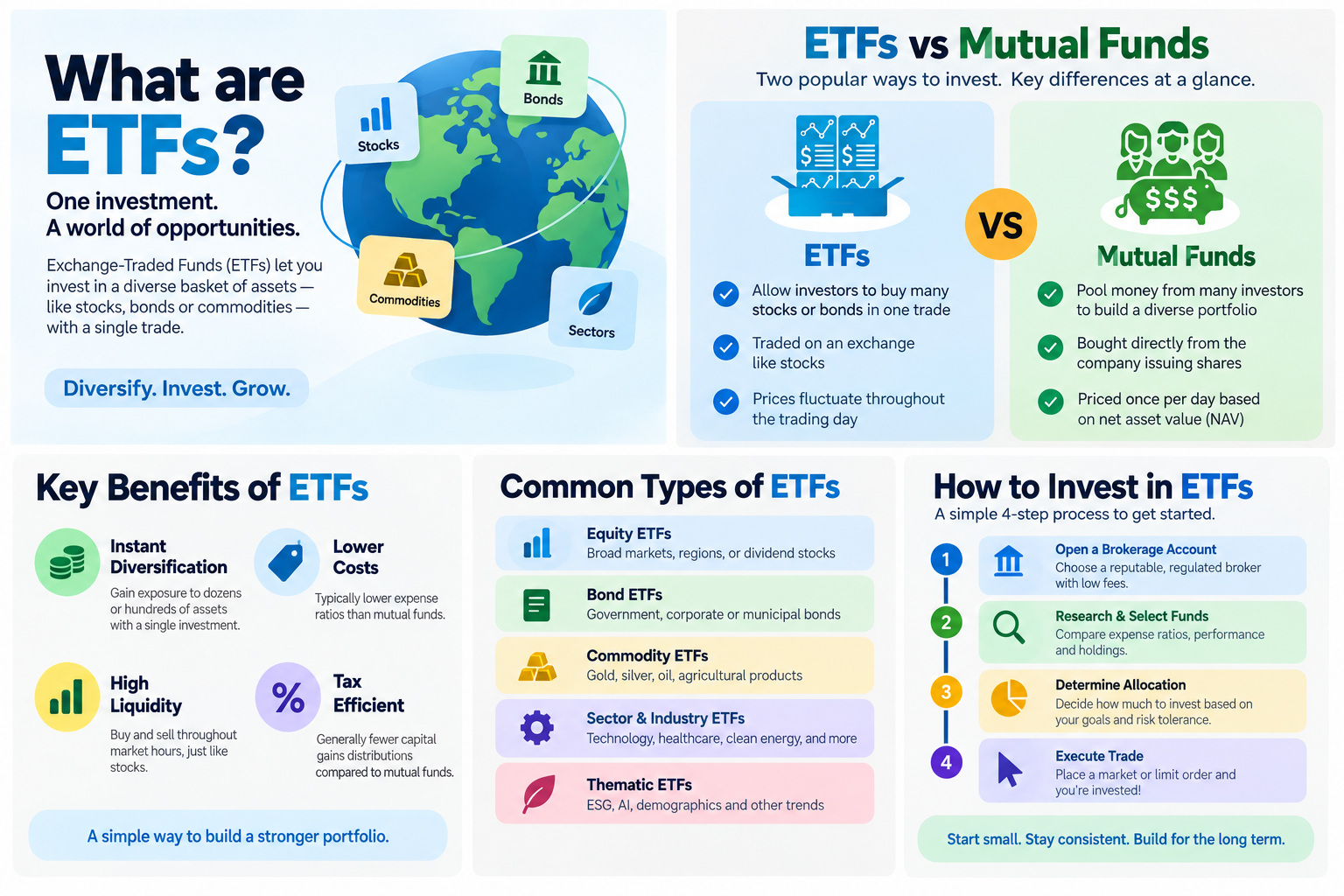
An exchange-traded fund (ETF) lets you buy a basket of assets in a single trade. Instead of purchasing dozens or hundreds of individual securities, one ETF can track a market index, sector, region, or strategy.
Whether you want exposure to the S&P 500, global stocks, government bonds, technology, gold, or emerging markets, there is likely an ETF designed for that. ETFs are especially useful when you want diversification, relatively low ongoing costs, and the ability to buy and sell during market hours.
For a one-page overview, see What are ETFs?. This guide goes further: types, accumulating vs distributing, UCITS, how to choose a fund, and how to build a simple long-term portfolio.
Key takeaways
- Diversification: One ETF can hold dozens, hundreds, or thousands of securities.
- Low costs: Many broad-market ETFs have relatively low expense ratios.
- Liquidity: ETFs generally trade throughout the day on an exchange.
- Transparency: Many funds disclose holdings regularly.
- Accumulating vs distributing: Some ETFs reinvest dividends automatically; others pay them out.
- Long-term building blocks: A few well-understood ETFs often beat a pile of overlapping tickets.
What is an ETF?
An ETF is an investment fund that holds a collection of underlying assets — stocks, bonds, government securities, commodities, real estate securities, currencies, or a mix.
You buy shares of the fund, not each security yourself. An S&P 500 ETF, for example, can give exposure to hundreds of large U.S. companies in one line.
Unlike a traditional mutual fund, ETFs trade on stock exchanges, so the market price can move throughout the session.
How they work
You could buy hundreds of large U.S. companies one by one. Or you buy an S&P 500 ETF: the fund holds the index constituents (or a sample of them), and one share is a slice of that portfolio.
Investor → broker → ETF → underlying assets
For an index ETF:
S&P 500 Index → S&P 500 ETF → investor
If the index rises, the ETF generally rises too — minus fees and other tracking differences.
Passive vs active ETFs
Not every ETF simply tracks an index.
Passive ETFs aim to replicate a benchmark: S&P 500, Nasdaq-100, MSCI World, FTSE 100, emerging-market indexes, government bond indexes. The goal is the index return, not stock-picking.
Active ETFs have managers who choose what to buy and sell — to try to outperform, generate income, or follow a strategy. Costs, turnover, and risk can look very different from a plain index fund.
Why people use ETFs
Instant diversification
Money in one company is a single bet. A broad equity ETF can spread that across hundreds or thousands of names. That does not remove market risk, but it reduces the impact of any one company blowing up.
Relatively low costs
Many passive ETFs charge a small expense ratio (the annual operating cost as a percentage of assets). An ETF at 0.10% costs about €1 per year per €1,000 invested, before market moves. Small fee gaps compound over decades.
Intraday trading
You can generally place orders while the market is open and see the price change during the session — unlike many mutual funds that price once a day.
Broad market access
ETFs can cover U.S., European, and emerging-market equities; government and corporate bonds; gold and energy; sectors; dividend, small-cap, value, and growth styles.
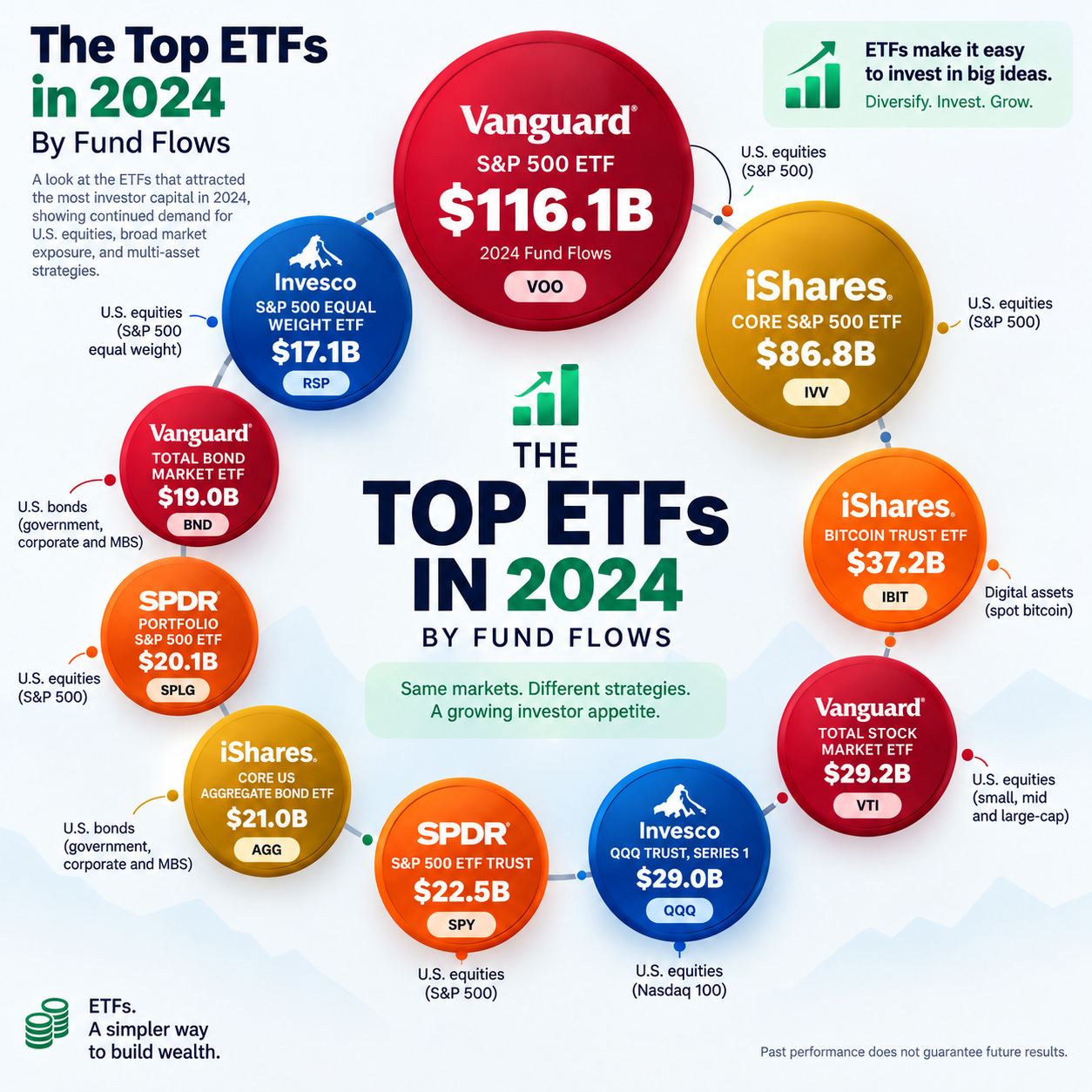
These examples are for illustration only. Popularity and past inflows are not a recommendation to buy any particular fund.
Transparency
Many ETFs publish holdings regularly, so you can see what you actually own.
The risks
ETFs are not risk-free. Risk follows whatever the fund owns. A short-term government bond ETF and an emerging-market tech ETF are different products that happen to share a wrapper.
| Risk | What it means |
|---|---|
| Market risk | If the holdings fall, the ETF falls |
| Concentration | “Diversified” funds can still be heavy in one sector, country, or a few mega-caps |
| Currency | Foreign-currency assets move your return even if the ticker is in EUR |
| Liquidity | Thinly traded ETFs can have wide bid–ask spreads |
| Tracking | The fund may lag its index after fees, taxes, and sampling |
| Interest-rate | Bond ETFs can fall when rates rise, depending on duration |
ETFs vs mutual funds vs individual stocks
| Feature | ETFs | Mutual funds | Individual stocks |
|---|---|---|---|
| Trading | Throughout the session | Usually once per day (NAV) | Throughout the session |
| Diversification | Usually high | Usually high | Depends on what you hold |
| Management | Passive or active | Passive or active | You |
| Expense ratio | Often low | Varies | No fund TER (you still pay spreads/commissions) |
| Company-specific risk | Usually reduced | Usually reduced | Can be extreme |
| Minimum | Often one share / fraction | Depends on the fund | Usually one share / fraction |
| Income | Distributing or accumulating | Distributions vary | Company dividends |
Both ETFs and mutual funds pool money into a portfolio. The structural difference is how they trade. Costs, tax, minimums, and availability vary by fund and country.
A single stock is a bet on one company’s earnings, management, debt, products, and regulators. An ETF can spread that — but a sector ETF can still drop hard if that sector drops. See Stocks vs ETFs for a shorter comparison.
Expense ratios (and what else to check)
The expense ratio (TER / OCF) is the annual operating cost. All else equal, lower fees leave more of the return invested. It should not be the only number:
- Tracking difference
- Fund size (AUM)
- Liquidity and bid–ask spread
- Index methodology
- Fund domicile
- Replication method (physical, sampling, synthetic)
- Distributing vs accumulating
Accumulating vs distributing
For many European investors this is the decision that matters most after “which index?”.
Accumulating (Acc) ETFs reinvest dividends and other income inside the fund. You do not receive a cash coupon; the NAV reflects the reinvestment.
Distributing (Dist) ETFs pay that income out — monthly, quarterly, semi-annually, or annually, depending on the fund. You then decide whether to spend it, hold cash, or buy more shares.
A practical UCITS example: Vanguard’s S&P 500 pair VUAA (accumulating) and VUSA (distributing). Same index; different dividend policy. Tickers are illustrations, not recommendations — always confirm ISIN, domicile, and the factsheet.
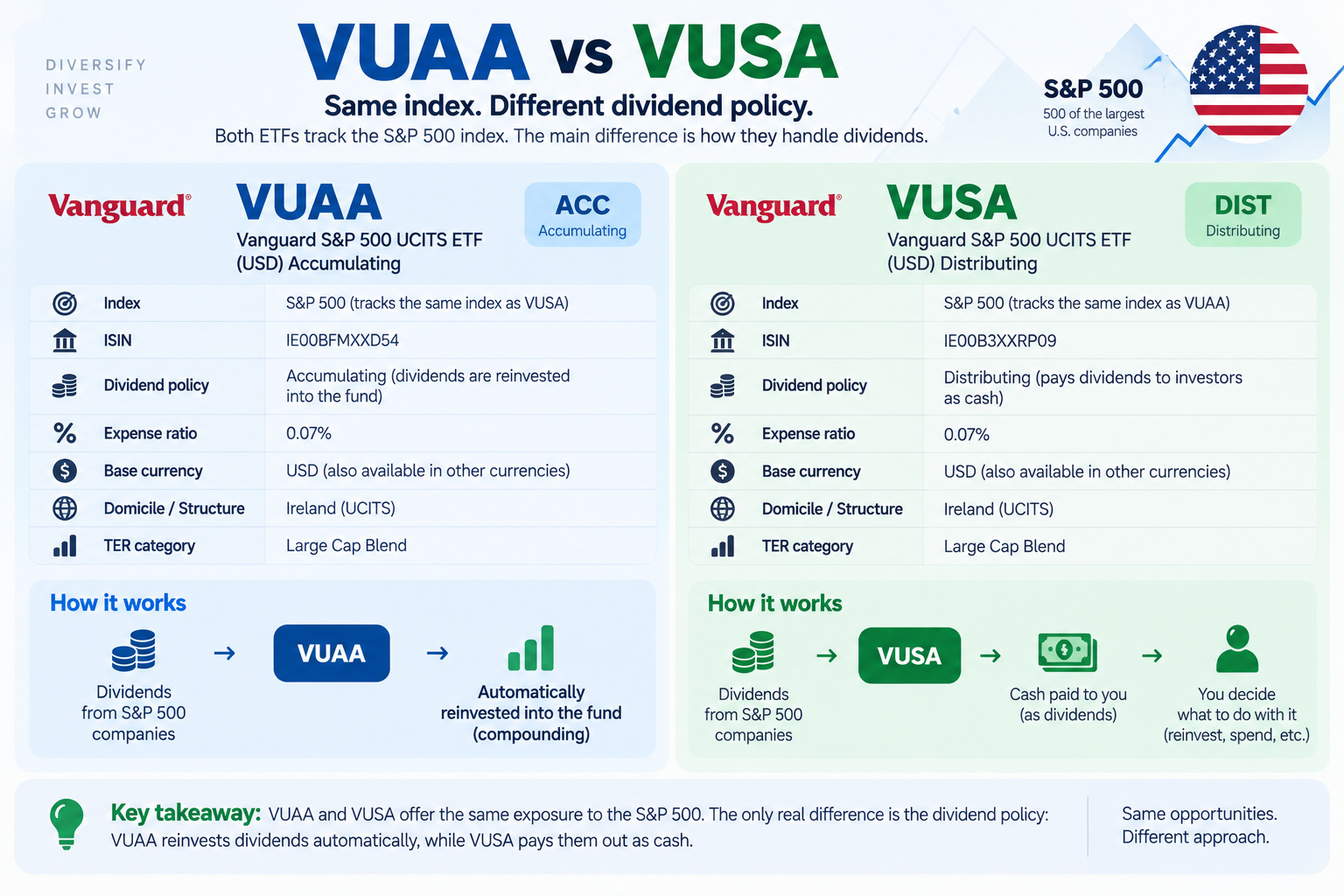
| Feature | Accumulating | Distributing |
|---|---|---|
| Dividends | Reinvested in the fund | Paid to you |
| Cash received | No regular dividend | Yes |
| Compounding | Automatic | Only if you reinvest |
| Manual work | Lower | Higher if you reinvest |
| Typical use | Long-term accumulation | Income, or control over cash |
Imagine two funds hold the same portfolio and receive €1,000 of dividends. Acc keeps the €1,000 inside the fund. Dist pays you €1,000. Over long periods, automatic reinvestment can contribute to compound growth if Dist distributions would otherwise sit in cash — tax treatment can change the comparison.
The illustration below uses a simplified example of a $10,000 investment in VUAA versus VUSA. It is not a forecast of future returns.
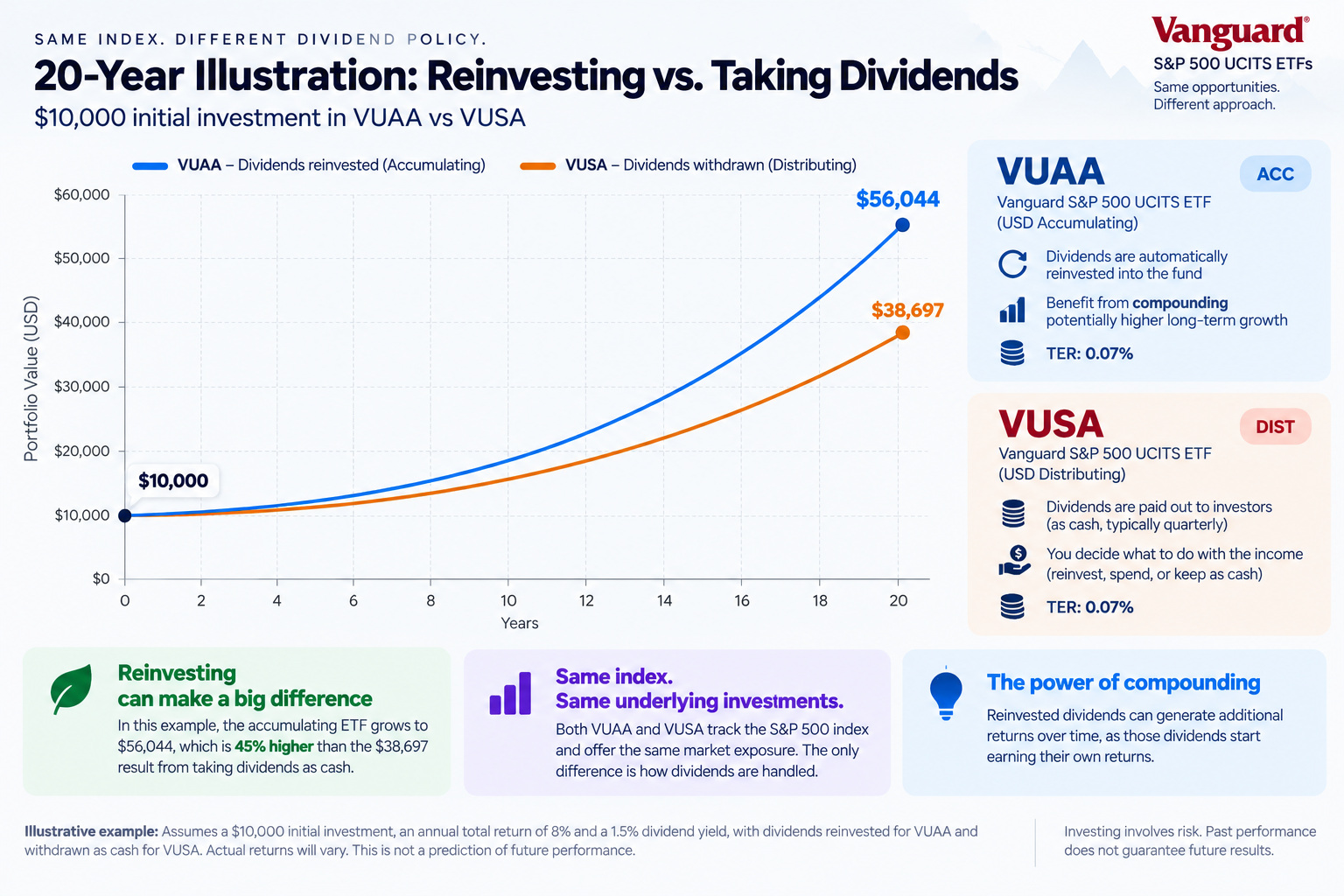
There is no universally better choice. Acc is convenient if you are investing for the long term and do not need income. Dist is convenient if you want cash flow or prefer to place dividends yourself. Tax rules vary by country and by fund domicile — check yours before choosing.
What UCITS means
UCITS (Undertakings for Collective Investment in Transferable Securities) is the EU fund framework many European retail ETFs use. Do not stop at the marketing name. Check:
- Fund name and ISIN
- Exchange ticker (the same fund can have several)
- Domicile and UCITS status
- Replication method
- Acc vs Dist
- Currency
- Expense ratio
The same index can have many ETFs, with different providers and structures.
Common types
Equity ETFs — global, U.S., Europe, emerging markets; large/small-cap; dividend, growth, value.
Bond ETFs — government, corporate, investment-grade, high-yield, short/long duration, inflation-linked. They diversify and can pay income, but they still have interest-rate and credit risk. See Bonds and bond ETFs.
Commodity ETFs — gold, silver, oil, gas, agriculture. Structures differ: physical metal, futures, or other wrappers. Read how exposure is created.
Sector ETFs — technology, healthcare, financials, energy, and so on.
Thematic ETFs — AI, robotics, clean energy, semiconductors, and similar stories. Targeted exposure; often more concentrated and more volatile.
How to choose an ETF
Past return is a weak starting point. Work through:
- What does it track? Index methodology, geography, sectors, number of holdings, largest names. What am I actually buying?
- Expense ratio — compare similar funds, together with tracking and trading costs.
- AUM — size is not quality, but tiny funds can be awkward to trade and more likely to close.
- Trading volume and spread — volume helps; the spread is the cost you actually pay.
- Tracking difference — fees, taxes, trading, rebalancing, sampling, securities lending, and replication all show up here.
- Domicile — regulatory wrapper and tax treatment; important in Europe.
- Acc or Dist — reinvest vs pay out.
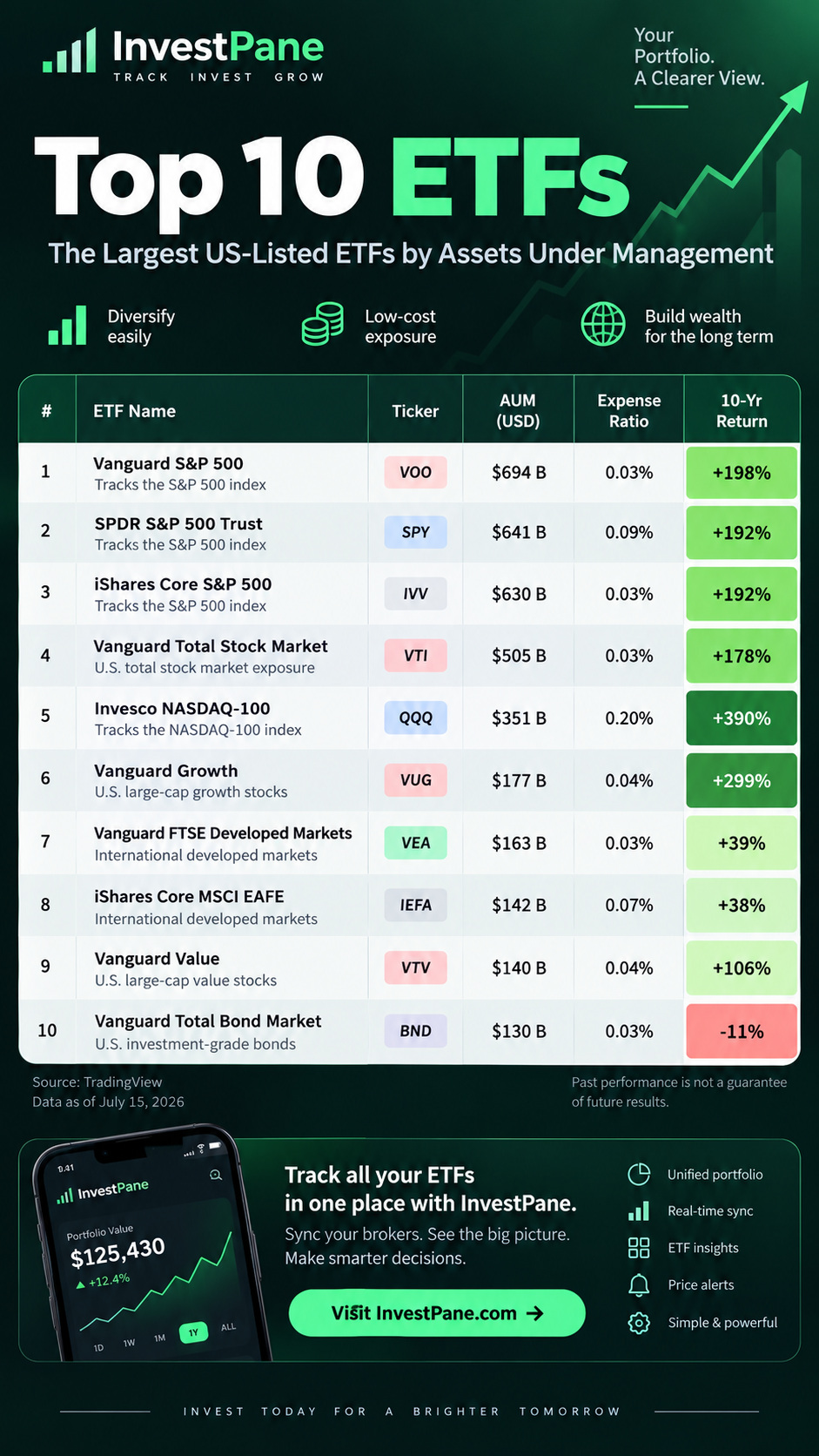
The table below shows some of the largest U.S.-listed ETFs by assets under management, together with tickers, expense ratios, and long-term returns. Use it as a way to practise reading those fields — not as a buy list.
How to buy an ETF
- Open a brokerage account at a regulated broker with the exchanges you need. Compare trading fees, FX fees, available markets, custody, fractional shares, and investor protections.
- Research the fund — ticker, ISIN, index, TER, AUM, holdings, domicile, distribution policy, tracking difference, spread.
- Decide the amount from goals, horizon, risk tolerance, and the rest of the portfolio.
- Place the order. A market order fills at the best available price (not guaranteed). A limit order sets the worst price you will accept; it may not fill.
If you hold the same ISIN at more than one broker, treat it as one position when you look at allocation.
A simple ETF portfolio
You do not need dozens of funds. Two common sketches (illustration only):
- Global equities + bonds
- U.S. equities + international equities + bonds
Fit the mix to horizon, risk tolerance, income needs, existing holdings, geography, and currency. The goal is to know what each line contributes, not to collect tickers. See How to build an investment portfolio.
Dollar-cost averaging
Invest a fixed amount on a schedule (for example €500 a month) instead of trying to pick the perfect day. It reduces timing stress; it does not remove market risk. More in Dollar-cost averaging.
Rebalancing
Markets drift weights. An 80/20 equity/bond mix can become 90/10 after a long rally. Rebalancing sells (or under-contributes to) the overweight sleeve and tops up the rest — on a calendar, at a threshold, or with new cash first. See Rebalancing your portfolio.
Common mistakes
- Chasing past performance — last year’s winner is not a plan.
- Ignoring fees — TER and spreads compound.
- Not reading holdings — “ETF” does not mean diversified. Some are one sector, one country, or a handful of names.
- Ignoring currency — a EUR-traded ticker can still be mostly USD assets.
- Confusing tickers — same fund, several exchanges, several tickers. Confirm ISIN.
- Skipping Acc vs Dist — two funds on the same index can handle income completely differently.
Checklist before you buy
- What does it invest in (index, strategy, holdings)?
- How much does it cost (TER and trading costs)?
- How large and liquid is it (AUM, spread)?
- How closely has it tracked the benchmark?
- Where is it domiciled, and is it UCITS if that matters to you?
- Accumulating or distributing?
- Does it fit the rest of the portfolio, your horizon, and your risk tolerance?
A simple framework
- Define the goal
- Set the time horizon
- Choose an asset allocation
- Pick ETFs that implement it
- Compare costs and tracking
- Invest consistently
- Monitor and rebalance occasionally
The useful skill is not finding the ETF with the best backtest. It is owning funds you understand and can hold through different markets.
Educational only — not personalised investment advice.