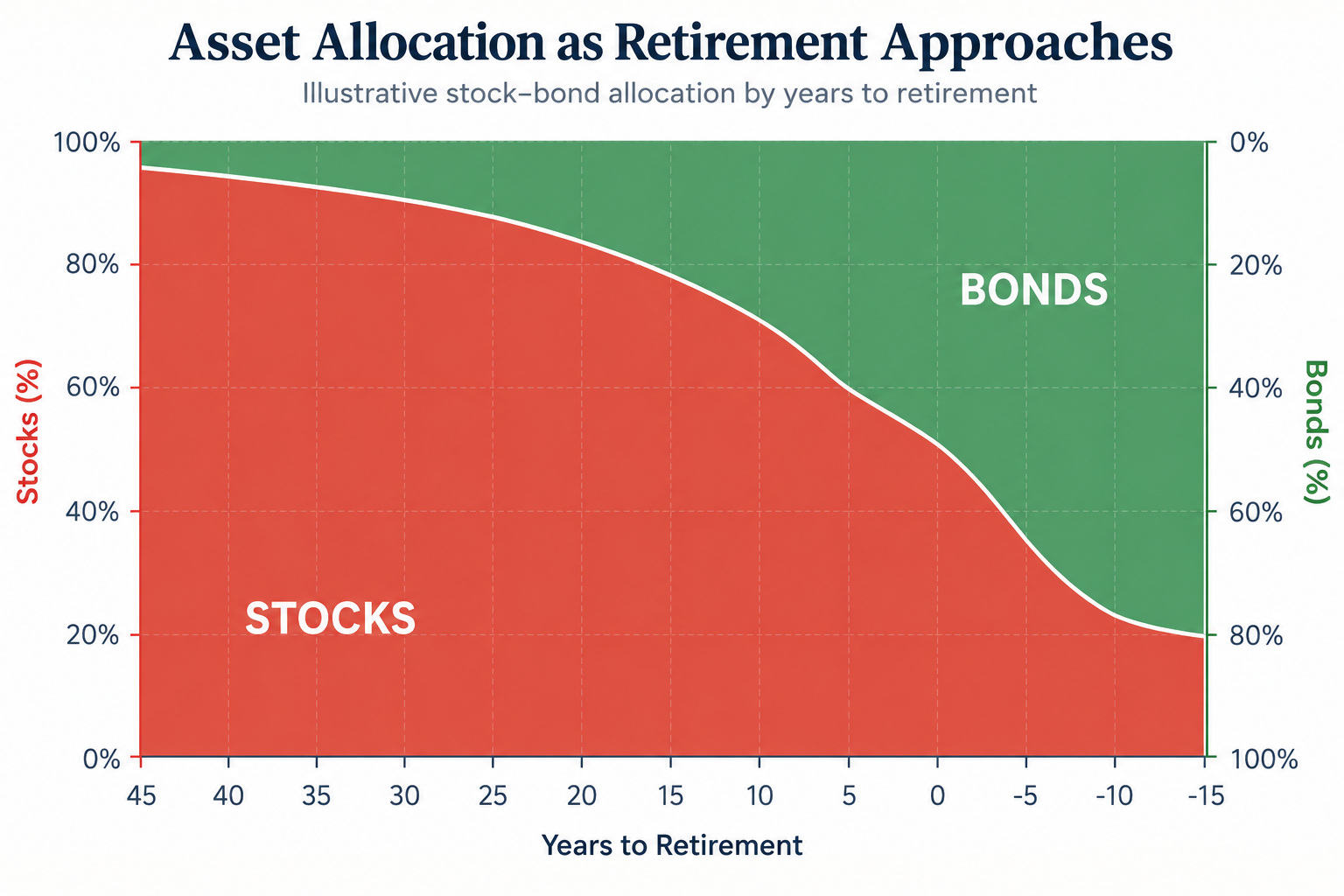
How much should you invest in stocks, bonds, cash and other assets at different stages of your life?
There is no single portfolio that is appropriate for everyone.
A 25-year-old with four decades until retirement can usually tolerate far more market volatility than a 60-year-old who expects to start withdrawing from their portfolio within a few years. But age alone does not determine the right allocation.
Your time horizon, financial situation, risk tolerance, income, debt, existing assets and retirement plans all matter.
Still, age provides an extremely useful starting point.
As retirement approaches, the role of the portfolio gradually changes. In your 20s and 30s, the primary objective is usually long-term growth. In your 40s and 50s, the focus increasingly shifts toward balancing growth with stability. Near and during retirement, protecting against large losses and sequence-of-returns risk becomes much more important.
This is why asset allocation should evolve throughout your life.
The younger you are, the more time you have to recover from market declines. The closer you are to needing your money, the more important stability becomes.
The goal is not to predict the next recession, interest-rate cycle or stock-market crash.
The goal is to build a portfolio that can survive all of them.
For the one-page version of the mix itself, see What is asset allocation?. This guide is the age and glide-path version.
The Big Picture: Asset Allocation by Age
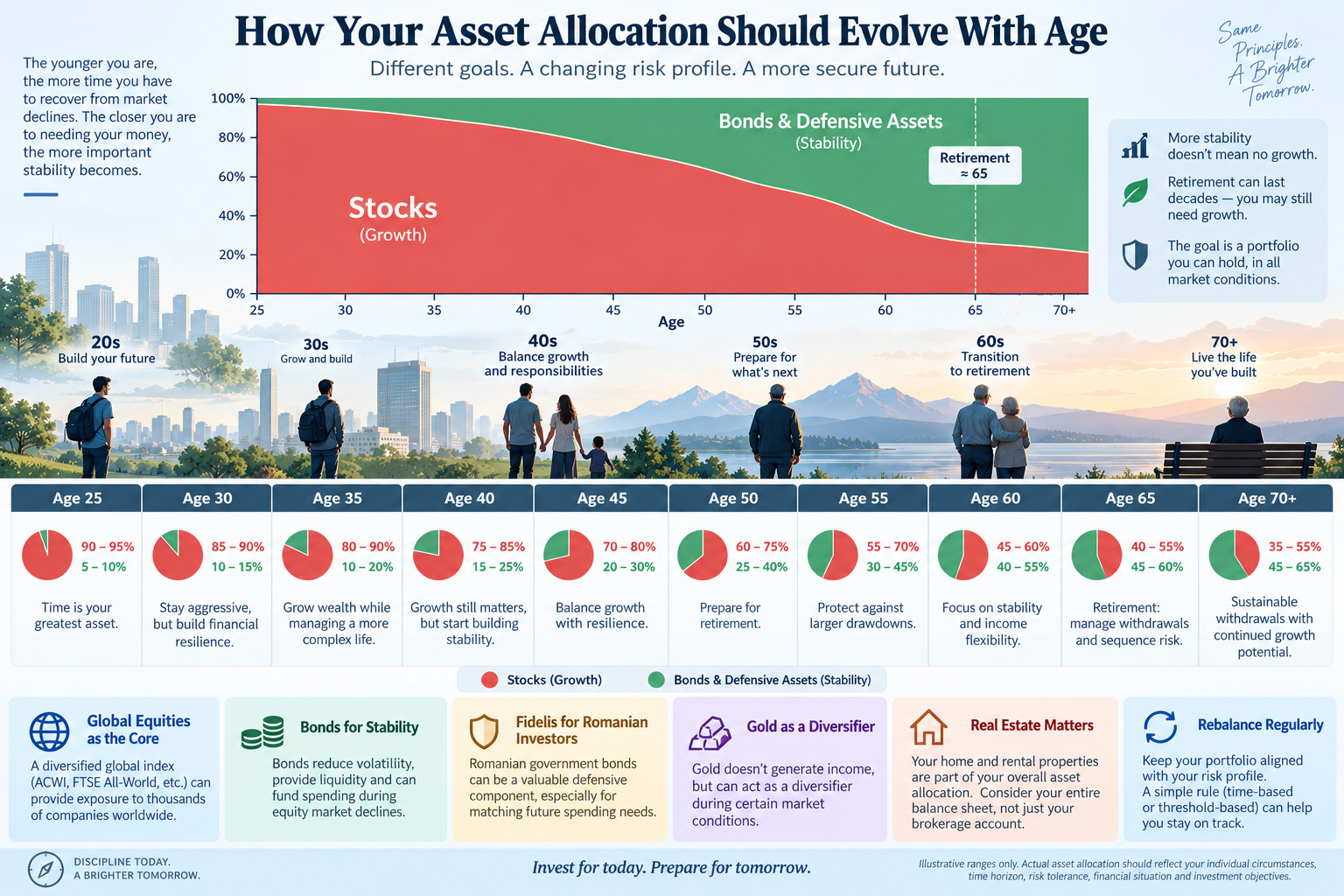
The following ranges are illustrative rather than universal recommendations. They assume a retirement age around 65 and a long-term investment portfolio.
| Age | Approx. years to retirement | Stocks | Bonds & defensive assets |
|---|---|---|---|
| 25 | 40+ | 90–95% | 5–10% |
| 30 | ~35 | 85–90% | 10–15% |
| 35 | ~30 | 80–90% | 10–20% |
| 40 | ~25 | 75–85% | 15–25% |
| 45 | ~20 | 70–80% | 20–30% |
| 50 | ~15 | 60–75% | 25–40% |
| 55 | ~10 | 55–70% | 30–45% |
| 60 | ~5 | 45–60% | 40–55% |
| 65 | Retirement | 40–55% | 45–60% |
| 70+ | Retirement | 35–55% | 45–65% |
These percentages should not be interpreted as a formula.
Two people of the same age can reasonably have very different allocations.
A 55-year-old with a large pension, rental income and substantial savings may have a very different risk capacity from a 55-year-old who depends entirely on their investment portfolio.
The table is therefore best understood as a glide path: a way of visualizing how the role of equities generally becomes smaller as the time until the money is needed becomes shorter.
1. Why Asset Allocation Matters More Than Picking the Perfect ETF
Investors often spend enormous amounts of time comparing ETFs:
- Which has the lowest TER?
- Which index performed better?
- Which ETF has the best dividend yield?
- Which country will outperform?
- Should I buy MSCI World or FTSE All-World?
- Should I add small-cap value?
- Should I buy gold?
Those questions matter.
But they are secondary to a much bigger question:
How much of your portfolio should actually be exposed to each type of risk?
Asset allocation determines:
- expected long-term growth;
- volatility;
- potential drawdowns;
- liquidity;
- sensitivity to interest rates;
- dependence on equity markets;
- ability to fund withdrawals;
- and how difficult the portfolio will be to maintain during a crisis.
The objective is not to construct the most complicated portfolio.
It is to construct one that you can continue holding when markets become uncomfortable.
2. Your 20s: Time Is Your Greatest Asset
Ages 20–29
For a young investor, the most valuable asset is not necessarily the money already invested.
It is time.
Someone who starts investing at 25 may have four decades before retirement.
That creates a huge advantage.
A severe stock-market crash can temporarily destroy a large percentage of the portfolio's value, but a young investor has many years to recover and continue contributing.
A long-term growth-oriented allocation might therefore look something like:
- 90–95% global equities
- 5–10% bonds, cash or other defensive assets
The equity component can be centered around a broad global index.
The objective is simple:
Capture global economic growth for as long as possible.
At this stage, the biggest mistake is often not owning too many stocks.
It is failing to invest consistently because of fear of short-term volatility.
3. Your 30s: Keep Growth High, But Your Financial Life Gets More Complex
Ages 30–39
Your 30s can still be an aggressive investment period.
You may have 25–35 years before retirement, depending on your circumstances.
But this is also when financial responsibilities often increase.
You may now have:
- a mortgage;
- children;
- a larger emergency fund;
- a business;
- significant real estate exposure;
- or other financial commitments.
This means your investment portfolio should not be considered in isolation.
Illustrative allocation
- 80–90% global equities
- 10–20% bonds and defensive assets
The exact allocation depends on your financial situation.
Someone with substantial cash reserves and stable income may tolerate considerably more equity risk than someone with high debt and uncertain income.
Your total balance sheet matters
Imagine two 35-year-olds.
Investor A has:
- €100,000 in global ETFs;
- €50,000 in cash;
- no debt.
Investor B has:
- €100,000 in global ETFs;
- a heavily leveraged property;
- a large mortgage;
- little cash.
Their brokerage accounts look identical.
Their overall financial risk is not identical.
This is why asset allocation should be considered across your entire balance sheet, not just your investment account.
4. Your 40s: Growth Still Matters, but Start Building Stability
Ages 40–49
At 45, retirement may still be approximately 20 years away.
That is a long investment horizon.
There is therefore still a strong argument for maintaining substantial equity exposure.
But the consequences of a major drawdown are becoming more important.
A possible framework is:
- 70–80% equities
- 20–30% bonds and defensive assets
This doesn't mean that a 45-year-old must automatically own 25% bonds.
It means that the portfolio is beginning to transition from:
maximum long-term growth
toward:
growth plus resilience.
This is also the time to look beyond stocks and bonds
By your 40s, your total wealth may include:
- your home;
- rental properties;
- business equity;
- pension rights;
- cash;
- stocks;
- bonds.
These assets all have different risk characteristics.
For example, owning several properties means that your household may already have substantial exposure to the real-estate market.
Adding more real-estate exposure through a REIT ETF may therefore create less diversification than it appears to on paper.
5. Your 50s: The Transition Toward Retirement Begins
Ages 50–59
The 50s are often where asset allocation becomes significantly more important.
At 55, retirement may be only 10 years away.
A 40% market decline is no longer merely a temporary inconvenience.
It could occur close to the point at which you need to start withdrawing money.
A possible framework is:
- 55–70% equities
- 30–45% bonds, government securities, cash and other defensive assets
The purpose of the defensive allocation is not necessarily to generate spectacular returns.
Its purpose is to create flexibility.
If equities fall sharply, you have assets that can potentially fund spending or rebalancing without requiring you to sell stocks immediately after a major decline.
6. Your 60s: Retirement Changes the Investment Problem
Ages 60–69
Once retirement approaches, the question changes.
During the accumulation phase, the main question is:
How much can my portfolio grow?
During retirement, the question becomes:
How can my portfolio fund my spending without taking unnecessary risk?
A possible starting framework around retirement might be:
- 40–55% equities
- 45–60% bonds, cash and defensive assets
But the correct allocation depends heavily on other sources of income.
Someone receiving a substantial pension may require a different portfolio from someone whose retirement depends almost entirely on investment withdrawals.
7. Fidelis: An Important Defensive Asset for Romanian Investors
For Romanian investors, government bonds deserve particular attention.
Fidelis securities can form part of the defensive allocation alongside:
- bank deposits;
- high-quality bond ETFs;
- short-duration bond funds;
- cash;
- other government securities.
One of their important characteristics is their defined maturity.
Suppose you know that you will need €20,000 in four years.
A government bond maturing around that period can potentially be used to match the future liability.
This is different from owning an open-ended bond ETF, whose market value fluctuates every day and which has no maturity date for the investor.
Fidelis vs. Bond ETFs
| Feature | Fidelis held to maturity | Bond ETF |
|---|---|---|
| Maturity | Defined | No fixed maturity for investor |
| Market price | Fluctuates before maturity | Fluctuates continuously |
| Diversification | Individual issue | Usually many bonds |
| Liquidity | Can be sold before maturity | Generally highly liquid |
| Interest-rate sensitivity | Relevant if sold before maturity | Reflected continuously in NAV |
| Cash-flow matching | Strong | Less precise |
| Credit exposure | Romanian government | Depends on ETF |
| Tax treatment | Depends on applicable Romanian rules | Depends on fund and investor |
A government bond is not the same thing as a risk-free asset.
There are still:
- sovereign risks;
- inflation risks;
- currency risks;
- reinvestment risks;
- liquidity considerations;
- and market-price risk if you sell before maturity.
The key advantage is that holding a bond until maturity can make interim price fluctuations much less important, provided the issuer makes the contractual payments.
8. Your 70s and Beyond: Don't Confuse Age With Investment Horizon
Reaching 70 does not automatically mean that your equity allocation should become extremely small.
Why?
Because retirement itself can last decades.
Someone retiring at 65 may potentially need their portfolio to support them for another 20, 25 or even 30 years.
That is still a long investment horizon.
A portfolio containing:
- 35–55% equities
- 45–65% defensive assets
may be a reasonable illustrative range for some retirees.
But again, the appropriate allocation depends on the individual's circumstances.
Someone with a large pension and substantial non-portfolio income may have a very different portfolio from someone who relies entirely on investments.
The important concept is:
Retirement does not eliminate the need for growth. It changes the balance between growth and stability.
9. The 120 Minus Age Rule
The classic rule of thumb is:
Stocks = 120 − your age
That produces approximately:
| Age | Stocks | Bonds / defensive assets |
|---|---|---|
| 25 | 95% | 5% |
| 30 | 90% | 10% |
| 35 | 85% | 15% |
| 40 | 80% | 20% |
| 45 | 75% | 25% |
| 50 | 70% | 30% |
| 55 | 65% | 35% |
| 60 | 60% | 40% |
| 65 | 55% | 45% |
| 70 | 50% | 50% |
The formula is useful because it captures a broad principle:
As investors age, their portfolios generally become less dependent on equities.
But it should not be treated as a law.
A different formula such as 110 minus age would produce a more conservative portfolio.
A younger investor with low risk capacity might also need a more conservative allocation.
An older investor with substantial pension income and a long legacy horizon might reasonably maintain significant equity exposure.
The formula is therefore a starting point—not a personalized answer.
10. The More Important Question: How Long Until You Need the Money?
Age is only a proxy for time horizon.
Time horizon is what really matters.
Consider three investors:
Investor A — Age 30
Retirement at 65.
35 years to retirement.
Investor B — Age 50
Retirement at 55.
5 years to retirement.
Investor C — Age 65
Retired, but with a pension covering almost all living expenses.
Their ages differ.
But the amount of money they actually need from their portfolios—and when they need it—can produce very different allocations.
This is why a better formula is:
Age → time horizon → risk capacity → asset allocation
rather than simply:
Age → asset allocation
11. The Core of the Portfolio: Global Equities
Regardless of age, the equity allocation can often be built around a diversified global index. See Investing in ETFs for how to choose one.
Examples include:
- MSCI ACWI
- FTSE All-World
- MSCI ACWI IMI
A global equity ETF can provide exposure to:
- North America;
- Europe;
- Japan;
- emerging markets;
- technology;
- financials;
- healthcare;
- industrials;
- consumer companies;
- and thousands of individual companies.
The objective is not to predict which country or sector will win.
It is to own a broad representation of global businesses.
12. Core-Satellite Investing
Once the core has been established, investors can add smaller satellite positions.
For example:
Core
80–95% of the equity allocation
in a broad global index.
Satellites
The remaining equity allocation could include:
- small-cap value;
- quality;
- individual stocks;
- sectors;
- emerging markets;
- thematic investments.
The key principle is position sizing.
A 5% satellite can be wrong without destroying the portfolio.
A 50% satellite can fundamentally change the risk profile of the entire portfolio.
13. Factor Investing: More Potential Return, More Tracking Error
Factor investing attempts to overweight characteristics such as:
- value;
- size;
- momentum;
- quality;
- profitability.
Small-cap value is one of the most discussed factor strategies.
Historically, certain factors have been associated with periods of higher expected returns.
But these premiums are not guaranteed.
A factor strategy can underperform the broad market for years.
This creates an important behavioral problem.
The investor may buy a factor strategy because of its historical performance and then abandon it precisely when the strategy is experiencing a prolonged period of underperformance.
Therefore:
A factor allocation should be small enough and intentional enough that you can continue holding it during years of disappointment.
14. Bonds: Their Job Is to Stabilize the Portfolio
Equities are primarily a growth engine. More on the ballast sleeve in Bonds and bond ETFs.
Bonds have a different job.
They can provide:
- lower volatility;
- liquidity;
- predictable cash flows;
- diversification;
- a source of funds during equity-market declines.
The purpose of bonds is therefore not necessarily to beat stocks.
The purpose is to make the overall portfolio more resilient.
15. Why Bond ETFs Can Lose Money
Bond investors sometimes assume that bonds cannot fall.
They can.
When interest rates rise, existing bonds with lower coupons generally become less attractive.
Their market prices therefore decline.
The sensitivity to interest-rate movements depends partly on duration.
A bond portfolio with a duration of approximately five years would, all else equal, be expected to move by roughly 5% for a 1-percentage-point change in yields.
This is why long-duration bond ETFs can experience significant declines when interest rates rise.
It doesn't mean the ETF has failed.
It means that bond prices are responding to changing market yields.
16. Ultra-Short Bond ETFs: Lower Duration, Not Guaranteed Cash
Ultra-short bond ETFs can be useful for investors who want relatively low interest-rate sensitivity.
They may provide:
- liquidity;
- short duration;
- diversified fixed-income exposure;
- an alternative to holding large amounts of idle cash.
But they are still investment products.
They are not identical to bank deposits.
Their value can fluctuate, and their returns depend on the securities held inside the fund, interest rates, credit quality and fees.
Think:
Cash-like fixed income
rather than:
Guaranteed cash.
17. Gold: A Diversifier, Not a Growth Engine
Gold can play a small role in a diversified portfolio.
Unlike stocks or bonds, gold:
- doesn't generate earnings;
- doesn't pay interest;
- doesn't distribute dividends.
Its potential role is diversification.
A relatively small allocation can provide an asset whose behavior differs from traditional stocks and bonds under certain market conditions.
But gold is not guaranteed protection against inflation or market crashes.
It can fall significantly and can experience long periods without producing a meaningful return.
For that reason, gold is generally better viewed as a portfolio diversifier than as the core of a retirement strategy.
18. Real Estate Changes Your True Asset Allocation
If you own property, don't ignore it when calculating your portfolio allocation.
A household might have:
- 60% stocks;
- 20% bonds;
- 10% cash;
- 10% real estate.
Another household might have:
- 40% stocks;
- 10% bonds;
- 5% cash;
- 45% real estate.
Their brokerage accounts might look similar.
Their total financial risk is very different.
Real estate creates exposure to:
- property prices;
- interest rates;
- local economic conditions;
- maintenance;
- vacancy;
- taxation;
- regulation;
- geographic concentration.
Your investment portfolio should therefore be evaluated as part of your entire balance sheet.
19. The Biggest Risk Near Retirement: Sequence of Returns
One of the most important reasons asset allocation changes with age is sequence-of-returns risk.
During accumulation, a market crash can actually help a long-term investor who continues making contributions.
They are buying assets at lower prices.
Retirement is different.
Imagine someone retires with €1 million.
In the first year, the stock market falls 30%.
At the same time, the retiree needs €50,000 to live.
They now have:
- a substantially smaller portfolio;
- plus withdrawals.
This can permanently damage the sustainability of the portfolio.
Now imagine another retiree with the same starting wealth and the same long-term average investment return—but who experiences strong returns during the first few years of retirement.
The two portfolios can have very different outcomes.
This is the sequence-of-returns problem.
20. The Cash Bucket Strategy
One way to reduce sequence risk is to maintain several years of planned spending in relatively stable assets. See also Cash in a portfolio.
A simple framework has three buckets.
Bucket 1 — Near-term spending
Cash and very short-term instruments.
Potentially covering approximately:
1–2 years of planned withdrawals
Bucket 2 — Intermediate spending
Government bonds, high-quality bonds and other defensive assets.
Potentially covering several additional years.
Bucket 3 — Long-term growth
Global equities and other growth assets.
This money remains invested for the long term.
The objective is not necessarily to spend the buckets in a rigid sequence.
The purpose is to reduce the probability that a market crash forces you to sell a large amount of equities at depressed prices.
21. How Much Should You Hold in Cash and Bonds?
There is no universal number.
Consider two retirees.
Retiree A
Receives:
- a large pension;
- rental income;
- other guaranteed income.
Their portfolio withdrawals may be relatively small.
Retiree B
Has no pension and depends almost entirely on investments.
Their liquidity requirements may be substantially larger.
Therefore:
The amount of defensive assets you need depends on your spending needs and other sources of income—not simply your age.
22. Rebalancing: Keep Your Portfolio Aligned With Your Risk
Suppose your target allocation is:
70% stocks / 30% bonds
A strong stock-market rally later turns it into:
82% stocks / 18% bonds
Your portfolio has become riskier without you explicitly deciding to take more risk.
Rebalancing brings the portfolio back toward its intended structure. The shorter version is Rebalancing your portfolio.
Two common approaches are:
Calendar rebalancing
Review the portfolio once or twice per year.
Threshold rebalancing
Rebalance when an asset class moves sufficiently far from its target.
For example:
Target: 70% stocks Rebalance below 65% or above 75%.
The important thing is not the exact method.
It is having a rule before emotions take over.
23. Tax Efficiency Matters
Asset allocation determines what you own.
Tax-efficient implementation determines how much of the return you ultimately keep.
For Romanian investors, this is particularly relevant because the tax treatment of investment income can change over time.
An accumulating ETF generally reinvests distributions internally rather than paying them directly to the investor.
That can make accumulating structures attractive for long-term investors.
However:
Accumulating does not automatically mean tax-free.
The eventual tax treatment depends on:
- the investor's tax residence;
- the fund's legal structure;
- the type of income;
- capital gains;
- distributions;
- the broker/intermediary;
- and the tax rules applicable at the time.
Tax optimization should therefore be part of implementation—not the reason for taking inappropriate investment risk.
24. Your Portfolio Should Become More Defensive Gradually
One of the most important ideas in age-based asset allocation is that the transition does not have to happen overnight.
You don't have to go from:
90% stocks → 50% stocks
the day you turn 60.
Instead, the portfolio can gradually move along a glide path.
For example:
Age 25       90–95% stocks
   ↓
Age 35       80–90% stocks
   ↓
Age 45       70–80% stocks
   ↓
Age 55       55–70% stocks
   ↓
Age 65       40–55% stocks
   ↓
Retirement   35–55% stocks
Educational only — not personalised investment advice.